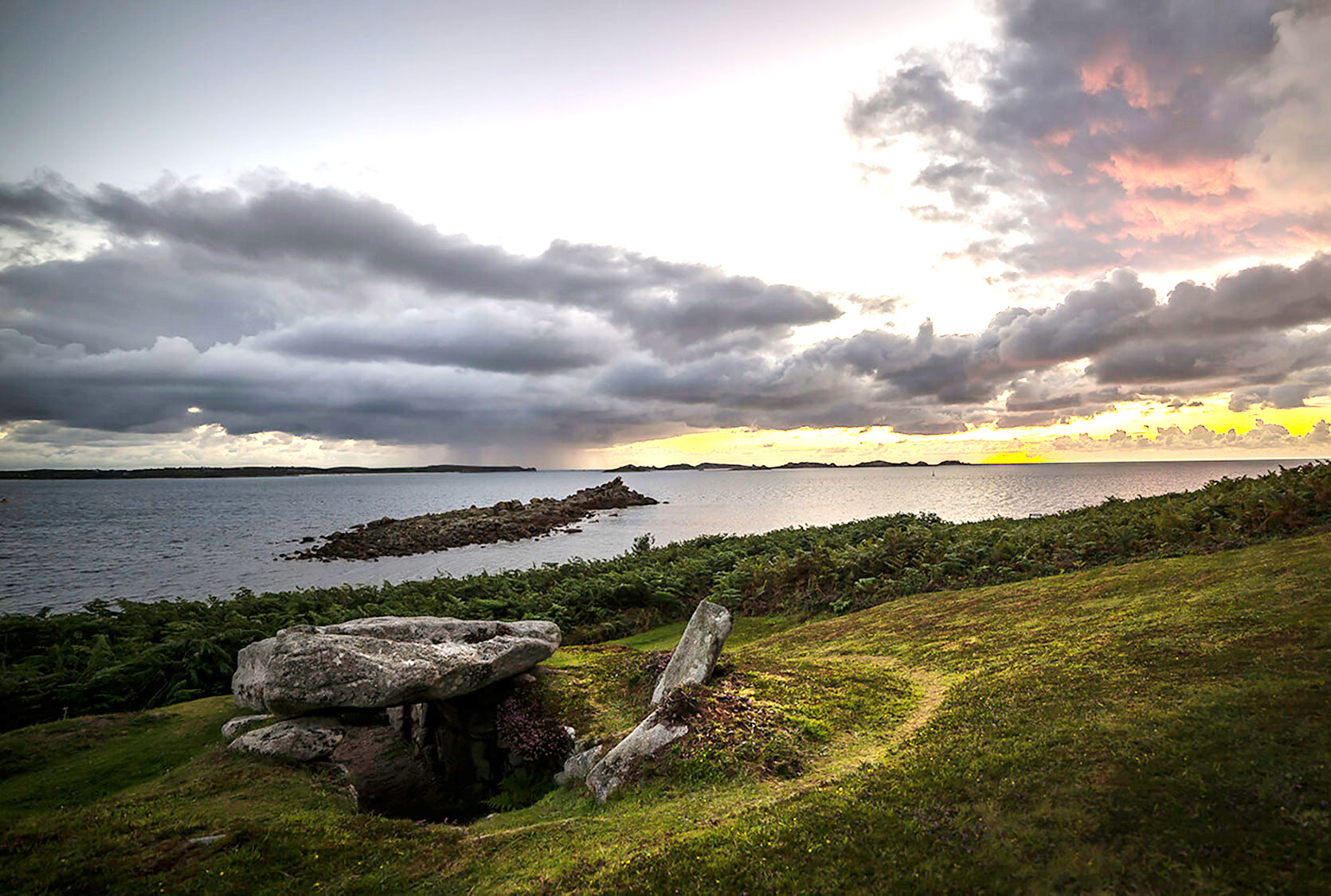
The Isles of Scilly have one of the greatest densities of historic sites in the whole of the British Isles, and St Mary’s is no exception. Most walks on the island will allow you close-up views of all manner of relics from the past – from Bronze Age burial chambers to World War II fortifications. Also well worth a visit are Obadiah’s barrow and the solitary Old Man of Gugh standing stone on St Agnes, and the Chapel Down stone idol on St Martin’s – thought to be around 3,000 years old.
Walking Through Time: An Archaeological Journey on the Isles of Scilly
The Isles of Scilly have a way of making you feel small in the best possible way. Not just because of the endless horizon or the Atlantic light, but because beneath your feet lies layer upon layer of human history. This is a place where archaeology isn’t locked away in museums — it’s woven into the landscape, scattered across windswept hills, hidden in hedgerows, and quietly eroding into the sea.
From the moment you arrive, Scilly feels ancient.
A Landscape Shaped by Prehistory
The Isles of Scilly are home to one of the densest concentrations of prehistoric sites in the UK. Many date back over 4,000 years, to a time when sea levels were lower and the islands formed a single landmass known as Ennor.
On St Mary’s alone, you can walk between Bronze Age entrance graves, standing stones, field systems and hut circles in the space of an afternoon. Sites like Bant’s Carn and Halangy Down on St Mary’s and Innisidgen on St Martin’s are stark reminders that these islands have been carefully inhabited and farmed for millennia.
What’s remarkable is how visible everything still is. There are no crowds or barriers — just low stone walls, grassy mounds, and the sense that you’ve stumbled across something quietly significant.
Island-Hopping Through the Ages
Each off-island has its own archaeological character.
On St Martin’s, the ancient settlement at Halangy Down reveals overlapping layers of Iron Age and Romano-British life, offering rare insight into how communities adapted over centuries.
Samson, now uninhabited, feels almost frozen in time. Scattered across the island are prehistoric field systems and hut circles, all slowly being reclaimed by grass and thrift. Walking here feels like stepping into an unfinished excavation.
St Agnes, the southernmost inhabited island in Britain, is dotted with cairns and chambered tombs. From Troy Town — a maze-like Iron Age settlement — to coastal remains now threatened by erosion, archaeology here is inseparable from the sea.
The Sea as an Archaeological Force
Rising sea levels have shaped Scilly’s story as much as its people. Entire settlements now lie submerged between the islands, and storms regularly reveal — and sometimes destroy — archaeological features.
This makes Scilly both a treasure trove and a fragile archive. Coastal paths often double as time lines, showing how communities retreated inland over thousands of years. In some places, ancient field walls disappear directly into the waves.
A Living Past
What makes archaeology on Scilly so special is how alive it feels. Locals know the sites, protect them, and often have stories passed down through generations. Guided walks can help put context around what you’re seeing — from prehistoric tools to shipwreck artefacts recovered from surrounding waters.
There’s no sense of rushing here. Archaeology becomes part of the rhythm of the day: a morning walk to a burial chamber, lunch overlooking a Bronze Age field system, and an evening spent watching the sun set behind stones that have stood for thousands of years.
Why Scilly Stays With You
You don’t need to be an archaeologist to feel the pull of the past on the Isles of Scilly. The history is quiet, open, and deeply human. These were islands of farmers, traders, sailors and families, living at the edge of the world and adapting constantly to change.
Long after you leave, it’s the image of those low stone tombs against a wide Atlantic sky that lingers — a reminder that Scilly isn’t just beautiful, it’s ancient.
And it’s still telling its story, one footstep at a time.